
Picture: TimesOnline
At first the villagers could not understand why their bouncing babies turned into small children who refused their food and complained of feeling ill all the time, agitated one moment but listless the next.
Then, early this summer, so many of the youngsters began to sicken after playing in fields of corn around a giant lead smelter, that the puzzlement turned to foreboding.
“We took the children to local hospitals but every time the doctors told us there was no problem,” said one mother.
Eventually, one father became so worried by his son’s convulsions that he telephoned a relative in Xi’an, the capital of Shaanxi province in the centre of China, which has first-class medical facilities.
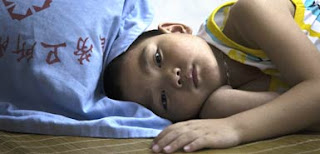
The family boarded a bus and made the 100-mile journey to Xijing hospital, where tests established that their baby had severe lead poisoning. When they returned, panic spread through the villages.
It was the start of a scandal that would explode onto the front pages of Chinese newspapers, only to vanish because of censorship, intimidation and a local cover-up that has now extended to restricting tests for the children.
The affair highlights the environmental price paid by many ordinary people for economic growth in a state that often ignores their interests.
A total of 851 children in seven villages were found to have excessive levels of lead in their blood. Some had 10 times the limit that China considers safe for children — 100mg per litre of blood. More than 170 were so seriously ill they had to be kept in hospital.
Lead poisoning damages the nervous and reproductive systems. It leads to high blood pressure, anaemia and memory loss. It is especially dangerous to toddlers, pregnant women and unborn children. The damage is usually irreversible.
On August 15, hundreds of farmers went to Fengxiang, the seat of local government, to ask for help. They sat outside its offices for two days but officials took no notice.
The Chinese countryside is supposed to be a place of placid toil but there have been occasions down the ages when it has exploded into violent revolt — and this was one of them.
On August 17, the farmers massed in their hundreds around the walls of the Dongling Lead and Zinc Smelting Company, a huge industrial complex looming above the rolling Shaanxi wheatfields.
They tore down part of a wall, broke into offices, wrecked computers, smashed cars, stoned the coal delivery lorries, blocked the factory’s railway tracks and sabotaged machinery. The managers fled.
The authorities sent thousands of police and plain-clothes security men to cordon off the villages. Running battles broke out along the rural roads and in muddy yards. “Hundreds of young men ran away to escape arrest,” said a villager.
The next day Dai Zhengshe, the mayor of Baoji, the nearest city, came to plead for calm.
China’s rulers were on the alert for trouble ahead of a grand celebration of 60 years of Communist party rule on October 1, so they did not want to take chances. Dai ordered the closure of the smelter.
That was the end of the story, as far as the Chinese media were concerned. It became an example of benevolent government intervention. As for the international media, police and plain-clothes toughs harassed reporters and threatened local people with dire consequences if they talked.
Then similar protests broke out in three other provinces, where horrified parents living near smelters of lead, copper and aluminium also learnt that their children had been poisoned — 1,300 of them in one city alone.
The spotlight moved on, local officials breathed sighs of relief and the young fathers stayed in hiding, all too aware of the state’s sly habit of concession followed by revenge.
The air still reeks in Changqing, the township that includes the plant and the tiny villages clustered around it. The corn has wilted and green vegetables planted in rows up to the smelter’s walls look pallid. The police cars and unmarked SUVs that kept reporters out are still there but in the soft rain of a central Chinese summer, the functionaries of the law prefer to stay dry.
By hiding in the back seat of a rural taxi, it was possible to slip past the roadblocks and enter the villages, where families eyed strange vehicles with suspicion. A few children played in the farmyards.
“You can see my house is only 50 metres from the lead factory,” said Zhang Mintian, a farmer. “On sunny days I couldn’t see the sun. On summer evenings I couldn’t open the windows, even though it was terribly hot. My nose and my ears were full of lead dust and smoke.”
Most of the 3,000 inhabitants of Madaokou, previously a thriving market crossroads, have gone. Of the seven villages that rose in revolt, this is the closest to the plant, right next to the walls.
“Why did our young people run away? They’re afraid of being arrested because it was they who tore down the wall,” said a man in his sixties.
“Who’d stay here?” asked an old lady, Bai Xiuying. “If you’re a man, how will you find a wife who wants to come and live in a poisoned village? If you’re a girl, who’s going to marry you if you come from here?”
Bai Xiyun, the oldest villager, added: “As an old man of 82 I feel guilty that I’m still living in this world when 800 babies have got lead poisoning. I know children mean the future. I wish I could change places with them.”
...
Inquiries made last week have revealed that officials have now ordered doctors to restrict the blood tests for lead poisoning as part of a campaign to stanch the protests.
“Every day farmers bring in their babies for examination and we can’t accept them,” a local doctor said. “We can only accept babies brought in by officials. And it’s policy that we’re not even allowed to perform examinations on children older than 13.”
An even more damning revelation came from a doctor at a general hospital in Baoji who, like the first doctor, cannot be named. In the past, said the doctor, blood samples used to be sent for high-grade heavy metals testing at an institute in Xi’an which has a national reputation.
“Suddenly the local government ordered this to stop. None of the staff could understand it. Our duty is to save lives. We were told that if anyone must be tested they should be sent for a less reliable test at a local health centre.”
The order left a bitter taste in the mouths of the staff. The doctor opened a drawer and pulled out two sheets of results showing grave levels of lead poisoning in 35 small children who were tested last month. The doctor wondered how many more there might be now and added, in a rare burst of frankness: “There’s a rich political hue to all this.”
Chinese journalists, who had at first conducted energetic investigations, found out that local officials had done a deal with the smelter company because they were desperate to meet their targets for economic growth.
Some of the villagers still have a yellow brochure that was handed out by the local government six years ago describing the plant as “a garden-like factory”.
The farmers nevertheless stood in their fields to block the construction machines. In October 2003, local officials organised 3,000 young thugs to cow them into submission.
“I was one of them,” confessed Zhao Xinping, now a driver. “We cut down their corn stalks and beat them up but now, frankly, I’m ashamed of it. Farmers in China are the poorest and the most honest of us all.”
Promises that the villagers would move to new homes more than 1½ miles from the smelter were never kept.
A source close to the company said that it had paid £18m for resettlement to the local authorities but the funds were never spent for that purpose. “Officials believed the farmers would never dare to rebel,” he said.
Soon Dongling Lead and Zinc Smelting was producing 100,000 tons of lead and zinc a year and 700,000 tons of coke. Last year it paid more than £10m in taxes, a sixth of the local government’s revenue.
Today the smelter is cold and silent. The government has promised a nationwide clean-up and says new pollutant controls must be installed.
The farmers have once again been promised new homes or a buyout of their land in cash and crops. Their children play on with an insidious poison in their blood. The police still stalk the villages. The officials brood and wait. Doubts and suspicions plague all sides.
The company is set to lose millions. And as a result, on the London Metal Exchange the price of lead has reached its highest level this year.
Pollution protests
- Ten thousand demonstrators took hostages and fought police at a $5 billion petrochemical project in Fujian on the east coast. The battles forced the local government to promise strict anti-pollution measures at the plant.
- Authorities closed a chemical plant in central China after two locals died of cadmium poisoning. Chinese newspapers exposed a long-running scandal of political collusion that had allowed the plant to flout environmental standards.
- Mass protests broke out over “cancer villages” near polluted waterways in eastern China. A series of campaigns followed to win compensation for villagers who became ill living next to filthy canals and rivers full of factory discharge and effluent.
I wish these were the exception to the rule but these problems are way too common for that to be the case.


 Posts
Posts


